
Blog
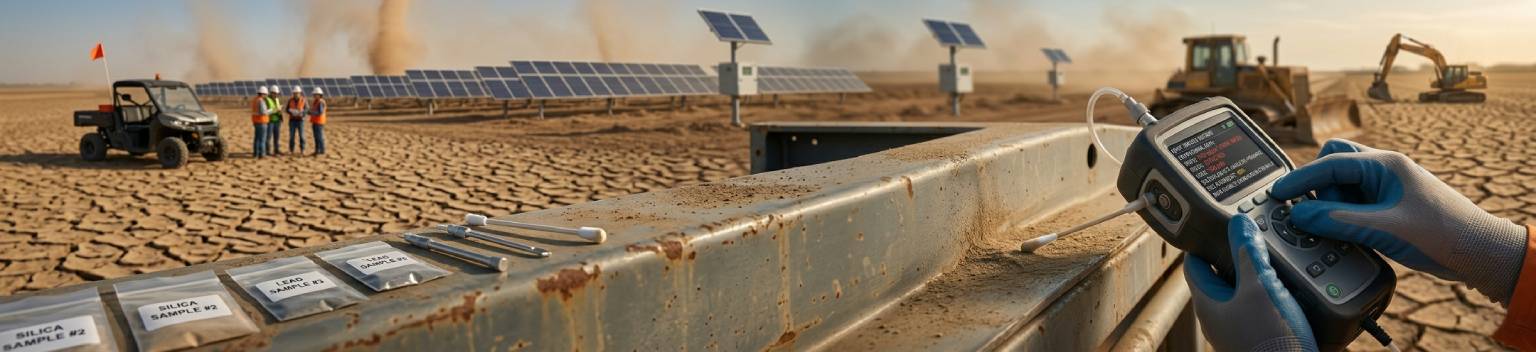 Read more: Dust Pollution: Health Risks, Climate Impacts and What the Science Says
Dust Pollution: Health Risks, Climate Impacts and What the Science Says
Dust is the most underestimated substance on Earth. Every year, roughly two billion tonnes of mineral dust are swept into the atmosphere from deserts, dried lakebeds and degraded farmland. It crosses oceans, seeds clouds, fertilises rainforests, carries toxic metals into our lungs — and may have catalysed the first organic…
 Read more: Impact measurement challenges: what the SSF Spotlight paper reveals
Impact measurement challenges: what the SSF Spotlight paper reveals
Impact investing now accounts for CHF 228 billion in assets under management in Switzerland alone. Yet a persistent question hangs over the industry: can investors actually prove the outcomes they claim to deliver? A new report from Swiss Sustainable Finance offers some of the clearest evidence to date that the…
 Read more: VSME and GRI: how the two frameworks connect
VSME and GRI: how the two frameworks connect
The Global Reporting Initiative (GRI) standards are the world’s most widely adopted voluntary sustainability reporting framework, used by organisations in over 100 countries. When EFRAG developed the VSME, it built the standard to be consistent with ESRS Set 1, which itself was designed with high interoperability with GRI — a…
 Read more: ESG rating penalties
ESG rating penalties
On 25 April 2026, the European Commission adopted a delegated regulation setting out the procedural rules for fines and periodic penalty payments that the European Securities and Markets Authority (ESMA) may impose on ESG rating providers under Regulation (EU) 2024/3005. The delegated act fills one of the final gaps in…
 Read more: From exposure draft to recommendation: how the VSME standard evolved
From exposure draft to recommendation: how the VSME standard evolved
The VSME standard that exists today — two modules, 20 disclosures, no materiality assessment, an “if applicable” principle — looks nothing like the version EFRAG first put out for consultation. The journey from a three-module exposure draft with a full materiality requirement to the streamlined Commission Recommendation adopted in July…
 Read more: ESMA publishes 2025 ESEF taxonomy: IFRS 18 dual entry points, implementation guide
ESMA publishes 2025 ESEF taxonomy: IFRS 18 dual entry points, implementation guide
On 21 April 2026, the European Securities and Markets Authority (ESMA) published the 2025 European Single Electronic Format (ESEF) XBRL taxonomy files alongside an updated ESEF Conformance Suite. These materials are designed to help issuers and software vendors prepare their 2026 IFRS consolidated financial statements using the most current version…
 Read more: The VSME Digital Template and XBRL taxonomy explained
The VSME Digital Template and XBRL taxonomy explained
When EFRAG issued the VSME standard in December 2024, it did not stop at publishing a PDF. It also released a Digital Template — an Excel workbook that SMEs can fill in and convert to machine-readable XBRL format — alongside an open-source XBRL taxonomy and an online converter. Now at…
 Read more: Defence and ESG: How the EU Is Redrawing the Line Between Security and Sustainable Finance
Defence and ESG: How the EU Is Redrawing the Line Between Security and Sustainable Finance
Regulation & Policy The EU has formally clarified: sustainable finance is compatible with defence. What does this mean for investors, reporting, and ESG data? Commission Notice C/2025/4950 and Delegated Regulation (EU) 2025/1775 redraw the line between security and ESG—narrowing automatic exclusions and reframing defence as a contributor to social sustainability.…
 Read more: VSME and CSRD/ESRS: how they connect and where the gaps are
VSME and CSRD/ESRS: how they connect and where the gaps are
The VSME and ESRS are not competing standards. They are part of a single reporting architecture designed by EFRAG to serve different sizes of company within the same sustainability data ecosystem. Large companies report under ESRS. Non-listed SMEs report voluntarily under the VSME. The critical connection between the two is…
 Read more: Switzerland 2030 Agenda SDG
Switzerland 2030 Agenda SDG
On 21–22 April 2026, the United Nations Economic Commission for Europe (UNECE) Regional Forum on Sustainable Development convened in Geneva to assess how member states are advancing the 17 Sustainable Development Goals (SDGs). Switzerland, as host country, used the forum to highlight both its domestic implementation and its international cooperation…

Subscribe to our Newsletter!
The latest news and events related to impact, risk, and sustainability around the world.